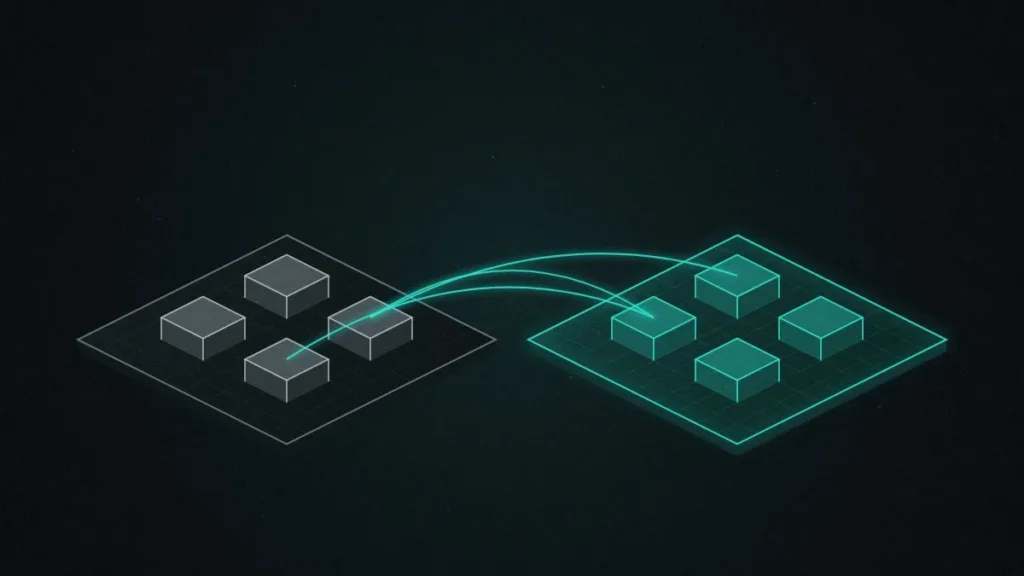
In many growing businesses there is one person who knows how everything fits together. Orders come in through one system, invoices go out from another, and stock or job details live in a third. Somewhere in the middle sits a member of staff who copies, checks and corrects, every day, so that all three agree.
Nobody designed it that way. It just happened. And because that person is reliable, the arrangement can run for years before anyone notices what it really is: a manual integration, held together by one pair of hands.
How the pattern forms
It usually starts sensibly. A business buys the best tool it can find for each job: a CRM for sales, an accounting package for finance, something else for operations. Each choice makes sense on its own. What nobody plans is how the systems will share information.
So the gap gets filled by people. First it is a few minutes a day. Then a spreadsheet appears to track what has been copied where. Then a set of personal checks, shortcuts and workarounds that only one person fully understands. Over time, that person stops doing their original job and becomes the connection between your systems.
What it actually costs
The obvious cost is time, but it is rarely the biggest one. The less visible costs tend to matter more:
- Errors that travel. A typo in one system becomes a wrong invoice, a missed delivery or an unhappy customer further down the line.
- Delay. Information only moves when the person moves it, so decisions wait for data that is a day or a week old.
- Holiday and sickness. When they are away, things quietly stop or go wrong, and the backlog lands on their return.
- Knowledge risk. If they leave, the business loses a process that was never written down, and often only finds out what it was when it breaks.
There is a human cost too. Being the only person who can keep things running is stressful, and it limits what that person can contribute elsewhere.
Why it stays invisible
This pattern hides well, for a simple reason: the person doing it is good at it. Problems get caught before anyone else sees them. Reports arrive on time, even if they took hours to assemble. From the outside, everything looks fine.
It also does not appear anywhere obvious. It is not a line on the IT budget or a software subscription. It sits inside someone’s job description, or more often outside it.
What changes it
The fix is not to find a faster typist or to replace all your systems at once. It starts with understanding the flow: which information moves between which systems, how often, and who relies on it. From there, the important decision is which system is the single source of truth for each type of data, such as customers, orders or stock.
Once that is agreed, connecting the systems becomes a much smaller and safer job. Some links can be automated quickly. Others may need a process change first. And the person who used to hold it all together gets their time, and their expertise, back for work that actually needs them.
If this sounds familiar, it is worth looking at before that person goes on holiday, or moves on.